
Don’t Look Away
By Kathy Kelly
16 September, 2026
After spending millions of dollars redecorating the White House and transforming D.C. monuments, President Trump approved, on September 15, 2026, an additional 2.8 billion dollar sale of heavy bombs to Israel, including 40,000 one-ton bombs, 20,000 of the 2,000 lb. bombs, and 20,000 bunker-busting penetrator warheads. Israel has used these bombs to destroy homes, families and crucial infrastructure in Gaza, the West Bank, and Lebanon.
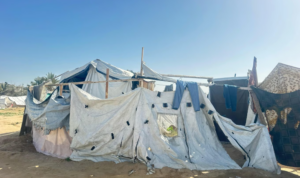
This latest U.S. weapons package will replenish Israel’s stockpile of bombs that human rights groups have condemned after documenting their use over the past two and a half years to kill, maim, bereave, and forcibly displace Palestinians. Survivors whose homes have been reduced to rubble now live in makeshift shelters, including flimsy tents, while Israel continues to restrict deliveries of supplies that could protect Gazans from harsh weather, disease, rodent and insect infestations, and other hardships of displacement.
In June of 2026, the Norwegian Refugee Council estimated that 170,000 households in Gaza, equivalent to nearly one million people, were living in tents. “Another 5,000 households sleep outdoors,” they reported, “while 52,000 households live in overcrowded shelters.” As Gazans enter the rainy and cold months of winter, they still lack emergency shelter items. They need plastic sheeting, plywood, and rope. Genocidal war and siege drive the crisis they face as the Israelis continue destroying Gazan homes and shelters and imposing restrictions which block desperately needed relief.
Over the past two years, members of the Global Solidarity for Peace in Palestine coalition have held weekly online meetings with Palestinians living in the West Bank. They update our coordinating committee about their experiences amidst ongoing, U.S. provisioned Israeli genocide against Palestinians. They speak with anguish about people in the West Bank and Gaza enduring persecution, travel restrictions, hunger, inadequate medical care, land theft, contamination, and an alarming rise in pogrom-style attacks by illegal settlers who are often assisted by Israeli military and police forces.
Our Palestinian coalition members living in the West Bank long to extend a helping hand to people trapped in Gaza. They recently raised the dilemma of Gazan children who have already lost years of education. Many live in wretched tent encampments, lack adequate food and medicine, and struggle with psycho-social traumas because of having lost their loved ones.
A Palestinian NGO, PYALARA, (Palestinian Youth Association for Leadership and Rights) suggested that our coalition could assist with practical measures to assist Gazan children who are eager to learn but who lack basic school supplies. The children are bereft of paper, pencils, pens, books, desks, and bookbags.
Recently, for UN News, an interviewer spoke with Julia Dicon, the Director of Education for UNRWA (United Nations Relief and Works Association). Dicon described what education means for Palestine refugee children and why sustained support is critical. She expressed deep respect for the many ways that Palestinians maintain capacities to educate their children, even in these dire times.
The interviewer asked her to tell a story about Palestinian young people who represent courage in the face of unspeakable adversity as they continue efforts to learn and teach.
Dicon talked about two Gazan sisters, 17-year-old Tala Mousa and her 15-year-old sister, Farah Mousa, who were recently named winners of the 2026 Middle East Earth Prize. The young women regularly looked at rubble surrounding their home which Israel had bombed. Unlike President Trump who is undertaking expensive and unnecessary renovations, they longed to rebuild homes which Israelis decimated, using U.S. manufactured bombs. Fala and Farah puzzled over how they and their neighbors could begin creating the indispensable equipment to reconstruct housing: bricks. Together, using their scientific knowledge, they developed a practical way to transform rubble into reusable blocks for garden beds, pavement, and partitions.
Tala and Farah represent the potential of Gazan youth to make a significant difference in their community’s lives and futures. Their energetic, practical and impassioned approach deserves our respect and support, while at the same time we must find creative ways to resist the merchants of death who benefit from the Trump administration’s purchase of their death-dealing weapons. Boeing, Lockheed Martin, RTX, General Dynamics, and Northrup Grummon are among the U.S. companies whose profits will continue to soar while the U.S. markets their weapons, “showcasing” them in war zones around the world.
We live in harsh, dark times.
The latest U.S. weapon sale to Israel further confirms U.S. complicity with Israel’s genocidal war crimes against Palestinians in Gaza and the West Bank. We must heed an urgent call issued by those most impacted by the war crimes: “Don’t look away.”
Photo credit: courtesy of Norwegian Refugee Council photo: Zyad Abu Mariam
Photo caption: Displaced Palestinians staying in flimsy tents.
Kathy Kelly, ([email protected]) is board president of World BEYOND War.