
Exposed: In Vietnam, USAID Funded the CIA’s Murderous Phoenix Program
By PIPR
3 July, 2025
Key points: USAID ran a project called CORDS. CORDS was the front of the Phoenix Program.
BACKGROUND
After imperial France lost its colony in 1954, Vietnam was divided under the Geneva Agreementsi into the communist North and the pro-American South. Fiercely independent, North Vietnam’s relations with Communist China and the Soviet Union were nuanced.ii Yet, American Cold War propaganda sought to portray the North as a client-state of the communist powers. The famous, leaked Pentagon Papers demonstrate that, in violation of the Geneva Agreements, successive US administrations used South Vietnam as a proxy to try to defeat the North. The goal was “to maintain a friendly non‐Communist South Vietnam [and] to prevent a Communist victory through all‐Vietnam elections.”iii
Presidents Eisenhower (1953-61) and Kennedy (1961-63) initially backed the South’s unpopular dictator, Prime Minister and later President, Ngô Đình Diệm (1955-63). Indeed, a CIA history notes that: “The question of Vietnamese leadership had already been decided” by the Eisenhower administration.iv USAID’s precursor, the International Cooperation Administration, collaborated with the Loan Fund to provide Diệm’s forces with counter-communist police and intelligence training.v With Kennedy’s approval, the CIA facilitated Diệm’s assassination when it became clear that his incompetent regime could neither defeat the North nor be reformed. Aid was soon focused on US-led efforts to organise anti-communist Army and guerrilla units.
USAID was established by President Kennedy under the Foreign Assistance Act 1961 and by Exeuctive Order. To give an exmaple of USAID’s links to intelligence, Kennedy had reportedly been considering appointing the corporate lawyer, Fowler Hamilton, to lead the CIA,vi but chose instead to make him head of USAID.vii The author and journalist, Marc Leepson, is a veteran of the Vietnam War. He concludes that in Vietnam, USAID’s “soul for the most part was molded in the minds of military men and spymasters.” From the outset, USAID was a propaganda tool designed less to provide material aid to deprived peoples and instead to support America’s presence in Indochina. Leepson describes it as a weapon in the “struggle for the loyalty of the South Vietnamese people.” The most prominent USAID influencer was William Colby, then-CIA Station Chief in Saigon and future Director of the Civil Operations and Revolutionary (later Rural) Development Support Program (CORDS). Colby would go on to head the CIA (1973-76). He claimed to favour the so-called soft-power of programs like CORDS over the relentless carpet-bombing that later came to symbolise the War.
C.I.A. INVOLVEMENT
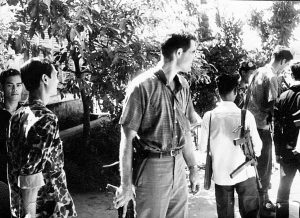
One not-so-soft-power project was the CIA’s notorious Phoenix Program (1968-73): a secret operation run by US Special Forces, Australian units, Chinese mercenaries, and anti-communist Cubans. Phoenix was a psychological operation targeted—to quote a US Navy report—“on disrupting, harassing, capturing, and eliminating local [Vietcong (communist)] infrastructure members.”viii Some 80,000 people were “neutralised,” including 26,000 dead, many of them civilians. A complement to the air war, the aim was to frighten the public into denouncing resistance to the US presence in Vietnam.ix
It turns out that USAID was running CORDS and CORDS was running Phoenix. An article in Military Review puts it bluntly: “From USAID, CORDS took control of ‘new life development’ (the catch-all term for an attempt to improve government responsiveness to villagers’ needs).” This included policing, housing refugees, and expanding the Chieu Hoi (Open Arms) program designed to support defectors. “CORDS made Phoenix a high priority and within weeks expanded intelligence centers in most of South Vietnam’s provinces.”x Another report notes that under CORDS, the South Vietnamese National Police Force increased its numbers from 75,000 personnel in 1967 to 114,000 by ‘72.xi
In neighbouring Laos, the US Air Force and the CIA’s Air America constructed Lima Site 36 in Na Khang village with the aim of conducting covert missions in the region. The Site was one of many used for operations, which included exporting heroin, a drug which the Agency used to fund some of its classified operations. In Laos, poppy cultivation was left to the CIA-trained General Vang Pao.xii USAID officials made the token gesture of proposing that Gen. Pao accept a grant to substitute poppy cultivation.xiii Pao rejected the idea, but the move had the effect of making it look as though one branch of US power was trying to do something to halt heroin production.
CONCLUSION
In February 1966, the North Vietnam Army and the Lao People’s Liberation Army launched a joint offensive against an outpost a few miles south of Lima Site 36. A CIA history reveals the involvement of USAID. Forces at the outpost were able to use radios supplied by USAID to request air support. The history also reveals the proximity with which USAID employees worked with CIA counterparts. One day after the assault, the Site was visited by USAID’s Refugee Operations Officer, Don Sjostrom, who arrived supposedly in an unauthorised capacity to provide language services to evacuated personnel. “Sjostrom had long since endeared himself to his CIA colleagues with his dedication to getting things done.”xiv Sjostrom was killed in another attack less than a year later.xvThe CIA and Pentagon, meanwhile, had started to use USAID as a conduit through which to funnel money into Laos to pay for their anti-communist guerrilla operations.xvi
PIPR does not write with AI, advertise, or collect your data. If you like our content and values, please consider donating.
SOURCES
i Geneva Agreements 20-21 July 1954, https://peacemaker.un.org/sites/default/files/document/files/2024/05/kh-la-vn540720genevaagreements.pdf.
ii Stephen J. Morris (1999) “The Soviet-Chinese-Vietnamese Triangle in the 1970s: The View From Moscow,” Woodrow Wilson International Center for Scholars, https://www.wilsoncenter.org/sites/default/files/media/documents/publication/ACFB2E.pdf.
iii Fox Butterfield, “Pentagon Papers: Eisenhower Decisions Undercut the Geneva Accords, Study Says,” New York Times, 5 July 1971, https://www.nytimes.com/1971/07/05/archives/pentagon-papers-eisenhower-decisions-undercut-the-geneva-accords.html.
iv Thomas L. Ahern (no date, circa 1993) “The CIA and the Government of Ngo Dinh Diem,” Studies in Intelligence (?), https://web.archive.org/web/20240815162801/www.cia.gov/resources/csi/static/ea78e45ca6dfe18637e8dc616ea239cd/Ahern-CIAandGovernmentOfNGODinhDiem-web.pdf.
v Marc Leepson (2000) “The Heart and Mind of USAID’s Vietnam Mission,” Foreign Service Journal, Spring, p. 21, https://afsa.org/sites/default/files/vietnamArchivedContentFromFSJ008.pdf.
vi New York Herald Tribune, “Fowler Hamilton is Reported Chosen to Be New CIA Chief,” 31 July 1961, https://www.cia.gov/readingroom/docs/CIA-RDP70-00058R000200130074-4.pdf.
vii John F. Kennedy Presidential Library and Museum, “Guide to the Fowler Hamilton Personal Papers (#96),” https://www.jfklibrary.org/asset-viewer/archives/fhpp.
viii Naval History and Heritage Command, “What is CORDS? ICTZ,” October 1969, https://www.history.navy.mil/content/dam/nhhc/research/library/online-reading-room/war-and-conflict/vietnam-war/CORDS/What%20is%20CORDS.pdf.
ix Douglas Valentine (1991) The Phoenix Program: America’s Use of Terror in Vietnam, Open Road.
x Dale Andrade and Lt. Col. James H. Willbanks (Ret.) (2006) “CORDS/Phoenix: Counterinsurgency Lessons from Vietnam for the Future,” Military Military, March-April: 77-91, https://web.archive.org/web/20231015074600/https://www.armyupress.army.mil/Portals/7/PDF-UA-docs/Andrade-Willbanks-UA.pdf.
xi Mandy Honn et al. (2011) “A Legacy from Vietnam: Lessons from CORDS,” InterAgency Journal, 2(2): 41-50.
xiiAlfred W. McCoy (1991) The Politics of Heroin: CIA Complicity in the Global Drugs Trade, Lawrence Hill Books, p. 19.
xiii Thomas L. Ahem (2006) Uncover Armies: CIA and Surrogate Warfare in Laos, 1961- 1973, Center for the Study of Intelligence, p. 544, https://nsarchive2.gwu.edu/NSAEBB/NSAEBB284/6-UNDERCOVER_ARMIES.pdf.
xivI bid., pp. 239-46.
xv University of Wisconsin-Madison, “USAID operations and CIA case officers,” no date, https://search.library.wisc.edu/digital/AA2RFE4CPSKBZ78P.
xvi John H. Holdridge, National Security Council Memorandum, 18 April 1972, https://web.archive.org/web/20230520150932/https://www.cia.gov/readingroom/docs/LOC-HAK-22-6-15-4.pdf.