
Installing Peace
By Kathy Kelly
25 May, 2026
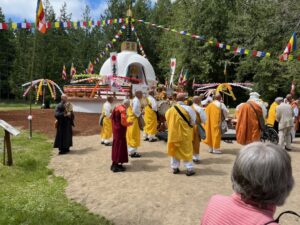
On May 23rd, in Poulsbo, WA, hundreds of people joined several dozen pacifist Buddhist monks from the Japanese based Nipponzan Myohoji religious order to install a Peace Pagoda immediately adjacent to the Kitsap Bangor U.S. naval base. An estimated 1,700 Trident nuclear weapons housed at the base have an annihilatory capacity unimaginably more terrible than the destruction and suffering the U.S. inflicted on Hiroshima and Nagasaki in August of 1945.
The foundational mission of the Nipponzan Myohoji monks calls on them to engage in worldwide pilgrimages urging abolition of nuclear weapons. They have been acutely conscious of the need to reach U.S. people.
Forty years ago, construction of this peace pagoda began on property owned by the Ground Zero Center for Nonviolent Action, a community devoted to abolishing nuclear weapons and war. Tragically, arsonists burned the initial pagoda structure to the ground. This weekend, celebrants signaled their gratitude and relief following four decades of effort to overcome hurdles which delayed completion of the peace pagoda.
During an outdoor celebration, the monks chanted, drummed, and prayed as they sat before the gleaming white stupa, colorfully festooned with prayer flags.
The peace pagoda represents readiness to fulfill Buddha’s call to love others, even enemies. By seeking release from attachments to anger or fear, followers of the Buddha aim to alleviate suffering in the world.
Since 1917, members of the Nipponzan Myohoji order, following the Buddha’s example, have left comforts of home and family, often entering war zones, always urging total disarmament.
Asked to speak briefly during the ceremony, I recalled being with international activists in 1991, shortly before the U.S. went to war against Iraq. As members of the Gulf Peace Team, seventy-seven of us encamped at a site used by pilgrims traveling through the Iraqi desert en route to Mecca.
We were determined to interpose ourselves between the warring parties. Included in our group were a Nipponzan Myohoji Buddhist monk and a lay member of the order.
When an air war broke out, we seemed unlikely to be in the way. Truthfully, we spent much of our time reading books and playing ping-pong in the desert. Yet the constant overflight of warplanes left us wondering if Baghdad and other cities might be completely destroyed.
Midway through the aerial war, anticipating a possible land invasion, the Iraqi dictatorship ordered evacuation of our Gulf Peace Team. Those tasked with the order had little choice. By sunrise, the following morning, buses were parked outside our camp, and four Iraqis asked us to take down the tents, pack our bags, and board the buses. Twelve of our members, people for whom I had utmost respect, decided to remain seated, in a circle, holding signs in Arabic and English that said, “We Choose to Stay.” I felt conflicted. I didn’t want the world to see images of Iraqi soldiers dragging peace activists through the sand. Reluctantly, I stood to the side.
One of the Iraqi men, Tarak, had previously visited our camp. Seeing the circle of twelve, he walked up to me. “Excuse me, Madame Kathy,” he asked, “but what am I to do?” I assured him the twelve meant no harm, but they couldn’t willingly board the buses. It was a matter of conscience.
Tarak nodded. Then he approached Jeremy Hartigan, the tallest man in the circle. Jeremy, a practicing Buddhist, softly chanted “Ohm,” as he sat, holding his sign.
Tarak bent over Jeremy, kissed him on the forehead, and pointed toward Iraq’s capitol city, saying “Baghdad!” Next, he and another Iraqi civilian, along with two soldiers lifted Jeremy Hartigan up, carried him to the top step of the bus, carefully situated him there and then asked, “Mister, you okay?”
I remember feeling astonished, thinking these folks could give workshops on nonviolence and start with the Chicago police. Now, I sadly wish those Iraqi officials could teach Israeli military and government people to abandon the brutal, taunting tactics they wield against Palestinians. Israeli forces have savagely tortured, maimed, displaced, starved, and assassinated civilians in the Occupied Palestine Territory and in surrounding countries. Last week, Israeli militarists and their cohorts brutalized humanitarian flotilla activists who attempted to break the genocidal siege of Gaza by opening a corridor to Gaza’s shores.
What a stark contrast between the Iraqi evacuation of peace activists in 1991, during a war waged by the countries many of us came from, and the U.S- provisioned Israeli violations of international law which normalize appalling crimes against humanity.
In 1991, the U.S. government and media goaded people to fear Iraqis. Then and still, U.S. billionaires have profited stupendously from such fears, gaining opportunities to develop, store, sell, and use huge weapon stockpiles.
U.S. mainstream media seldom mentions the Shimon Peres Nuclear Research Center, an Israeli nuclear installation located in the Negev desert. The CIA estimates that Israel possesses at least ninety-one thermonuclear weapons, yet Israel continually flaunts international law by refusing to acknowledge its nuclear armaments.
Today, in our war-ravaged world, the witness of those who revere the peace pagoda reminds me of Tarak kissing Jeremy Hartigan’s forehead. I hope the Buddhist monks’ message will be installed in the hearts and minds of innumerable people, stretching across borders and reaching future generations.
Photo supplied by Kathy Kelly
Kathy Kelly, ([email protected]), an author and peace activist, is board president of World BEYOND War.